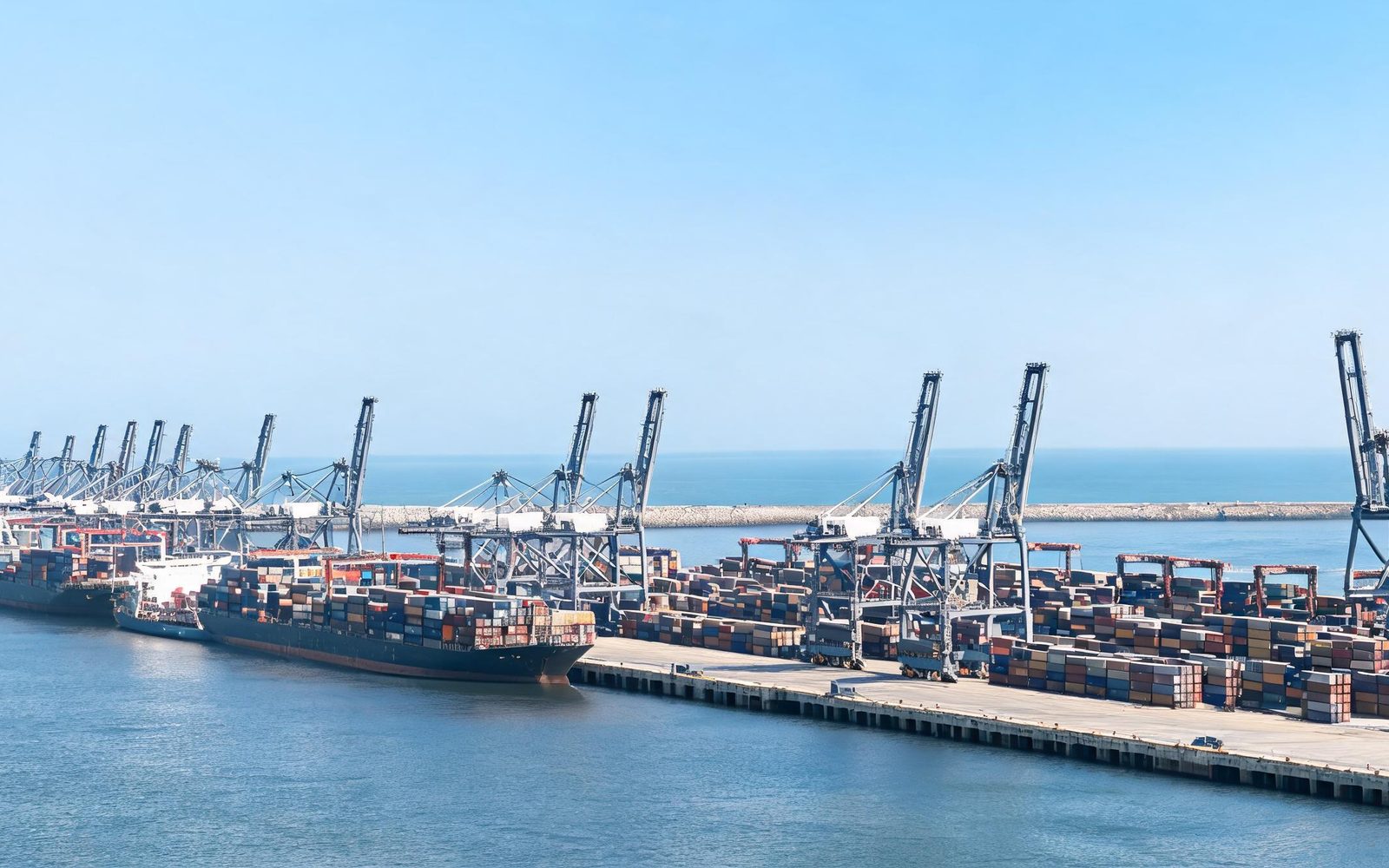
Pakistan's seaborne trade passes overwhelmingly through two ports, both near Karachi. Karachi Port sits at the western edge of the city; Port Muhammad Bin Qasim lies to the east, in the Indus delta. Between them they carry the great majority of the country's container, bulk and liquid cargo.
Because they serve the same national hinterland, the two are often discussed as a single system. That framing hides real differences: they were built differently, are governed separately, and face different physical constraints. Understanding those differences is the starting point for any serious discussion of port capacity and congestion in Pakistan.
Two ports, one national gateway
Karachi Port and Port Qasim function as a pair. They draw on the same industrial base around Karachi, feed the same upcountry markets, and both operate under the Ministry of Maritime Affairs. A disruption at one is felt at the other, because cargo that cannot be handled at one berth does not disappear; it reroutes or queues.
The consequence is that Pakistan's port capacity is best read as a combined figure, while the constraints that determine it remain separate and have to be understood one port at a time.
Karachi Port: a natural harbour inside a city
Karachi Port is a natural deep-water harbour, which is why it developed as the country's original principal port. Its location is also its central constraint: it sits within a major metropolitan area, so the port, the city's road network and the surrounding districts are physically interleaved.
The port is managed by the Karachi Port Trust, a federal authority responsible for its infrastructure, berths and marine operations. Its position close to the city gives it a natural advantage for time-sensitive and containerised trade, but it also means that inland cargo must move through urban traffic.
With little room to expand outward, development at Karachi Port tends to mean deepening, reconfiguring and intensifying the use of existing space.
Port Qasim: an industrial port behind a dredged channel
Port Qasim was developed later, and deliberately, as a second gateway to relieve pressure on Karachi and to serve heavy industry. It is a landlord port, managed by the Port Qasim Authority, which provides the marine infrastructure and leases terminals and industrial land to operators.
Its defining feature is the approach channel. Vessels reach the berths through a long, dredged channel through the delta, and maintaining it is an ongoing engineering obligation. The channel's depth and width effectively set the largest vessel the port can receive, which is why dredging is a recurring subject in its planning.
Port Qasim also adjoins major industrial installations and dedicated industrial zones, giving it a different cargo profile from Karachi Port.
What each port tends to handle
The two ports overlap, but their centres of gravity differ. Karachi Port, with its urban setting and container-focused berths, is strongly associated with containerised and general cargo. Port Qasim, with its industrial hinterland and larger landside area, is associated with bulk and industrial cargo, including energy imports.
- Karachi Port: a natural harbour close to the metropolitan market, with a strong container and general cargo role.
- Port Qasim: a landlord port behind a dredged channel, with large landside area and a strong bulk role.
- Energy imports and heavy industry are concentrated at Port Qasim.
- Both ports serve the same national hinterland and upcountry markets.
Governance: two authorities, one ministry
The Karachi Port Trust and the Port Qasim Authority are separate federal bodies, each with its own board, tariff structure and development mandate. This mirrors the landlord model used in many countries, where the state owns the land and marine infrastructure and private operators run the terminals.
Separate authorities can each focus on their own port, but coordination across the two — on channel usage, rail links and inland logistics — depends on mechanisms above the authority level. Where those are weak, the ports can end up competing for the same cargo rather than complementing each other.
The constraints: channel, land and connectivity
Each port's limits are of a different kind. Karachi Port's constraints are landside: space within the city, road access, and moving large volumes through an urban environment. Port Qasim's constraint is marine: the approach channel, which must be maintained and which determines vessel size.
Both share a third constraint: connectivity to the interior. A port's effective capacity is not only its berths but the rate at which cargo can be moved out and into the country. Inland transport by road and rail, and the corridors connecting Karachi to the north, matter as much as what happens at the quay.
How to read the comparison
The comparison is not a contest between a better and a worse port. The two were created at different times for different reasons and remain complementary parts of one gateway. The useful questions concern fit: which cargo suits which port, and where capacity should be added.
Those questions are answerable, but only with data on throughput, dwell times, channel usage and inland movement that is consistent across both ports. Building that evidence base is the unglamorous precondition for sound port policy.
Frequently asked questions
- Are Karachi Port and Port Qasim the same organisation?
- No. They are separate federal ports, managed by two different authorities — the Karachi Port Trust and the Port Qasim Authority — though both operate under the Ministry of Maritime Affairs.
- Why does Port Qasim have an approach channel?
- Because it was built in the Indus delta, where natural water depth is insufficient for large vessels. Ships reach its berths through a long, dredged channel that must be maintained, and the channel's dimensions set the largest vessel the port can receive.
- What is the main constraint on Karachi Port?
- Space. It is a natural harbour surrounded by a major city, so its limits are landside — berth space and road access — rather than the depth of its water.
- Which port handles more cargo?
- The two handle different mixes, and the answer depends on whether you measure containers, bulk or total tonnage. It is more useful to compare cargo mix and check the latest published figures than to rely on a single headline number.
Conclusion
Karachi Port and Port Qasim are best understood as one gateway with two very different halves. Karachi Port is a natural harbour embedded in a city, strong in container and general cargo but limited by land. Port Qasim is a planned industrial port behind a maintained channel, strong in bulk cargo but constrained by dredging and marine access. Both depend on inland connectivity that neither controls.
Drawing that distinction matters because it points to different remedies. Karachi Port's future lies in reorganising its urban footprint; Port Qasim's lies in maintaining its channel and landside industrial capacity. Treating the two as a single problem invites solutions that fit neither.
PMRC works on port economics, shipping and logistics within its research programme, and supports institutions that need independent analysis of Pakistan's maritime trade infrastructure.