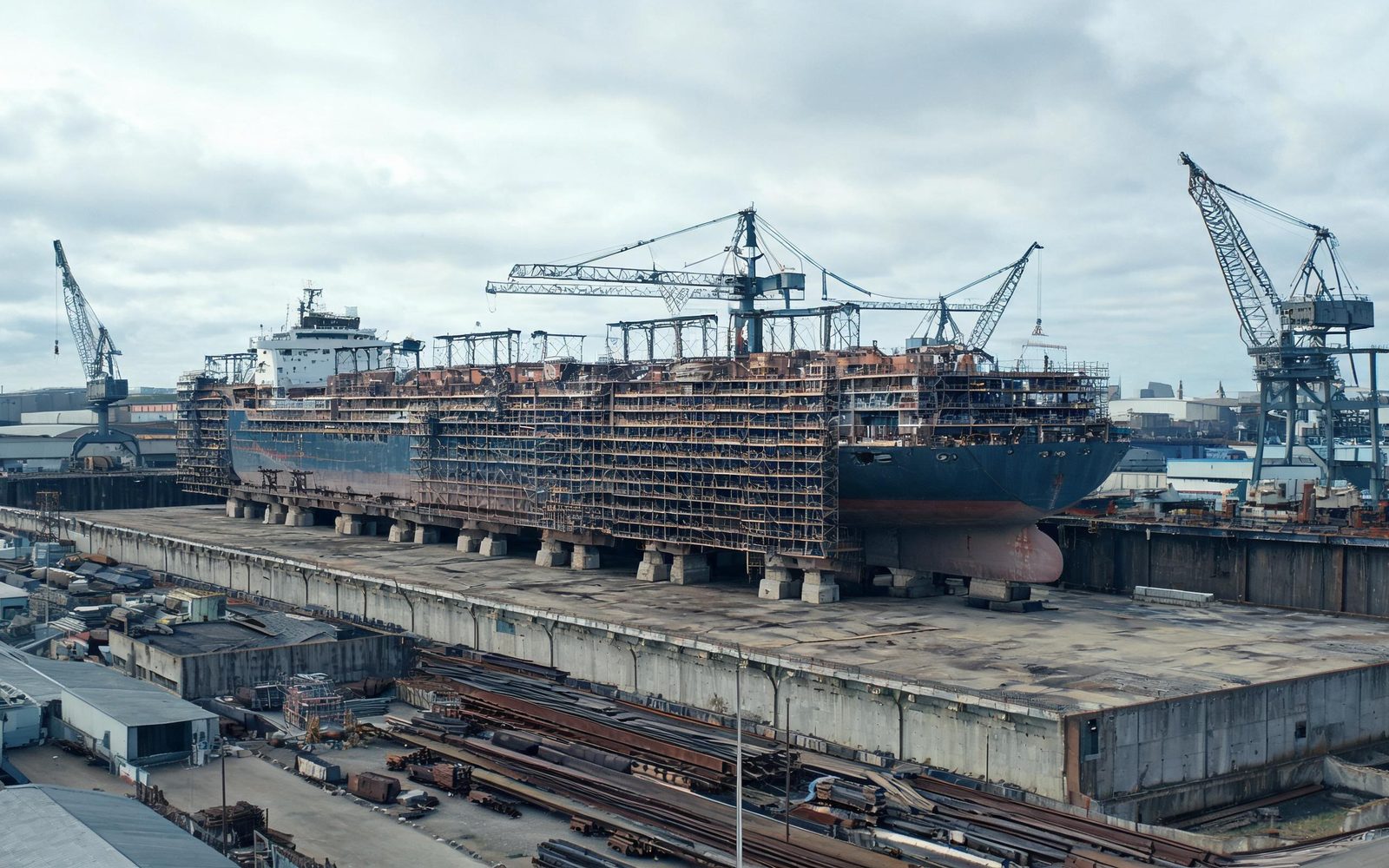
Pakistan is a trading nation whose economy depends heavily on moving goods by sea, yet the ships carrying that trade are overwhelmingly foreign-flagged. The country's own merchant fleet is small relative to the cargo volume it generates, and the gap has persisted across decades and successive statements about the importance of national shipping.
The imbalance matters because freight is a services export, and because reliance on foreign tonnage limits influence over the cost, availability and routing of national trade. This article examines why the gap persists and what reform would have to address.
A trading nation with a small fleet
Pakistan's merchandise trade moves almost entirely by sea, and almost entirely on vessels owned and operated outside the country. The national fleet, anchored by the state-owned Pakistan National Shipping Corporation, accounts for a very small share of the tonnage carrying the country's imports and exports.
Global shipping is highly concentrated: a small number of countries and owners control most world tonnage, and shipping is a capital-intensive, cyclical business where scale confers real advantages. Pakistan is not unusual among developing economies in having a small fleet, but it is notable for the extent to which its trade depends on seaborne transport.
Why a national fleet matters
The case for national shipping is often framed strategically, but its more immediate justification is economic. Freight is a service, and when it is provided by foreign carriers the value is earned abroad. A larger national fleet would retain some of that value domestically, along with associated employment and maritime services.
There is also a resilience argument. During global disruptions — conflict, pandemics or congestion — freight rates can rise sharply and capacity can be allocated away from marginal routes. A country with its own tonnage has more options than one competing for space on the spot market.
The counter-argument is that shipping is a global market, and that a country can often buy the service more cheaply than it can provide it. That is frequently true in stable conditions, which is why fleet policies need justification beyond sentiment.
The capital problem: how ships are financed
The first and largest obstacle is finance. Ships are expensive, long-lived assets bought in global markets, and the structures that support acquisition — long-tenor debt secured against the vessel, shipyard credit, leasing and specialist maritime banks — are most developed in a few maritime centres.
In Pakistan, ship acquisition has historically depended on limited capital sources and on the balance sheets of a small number of entities, notably the national carrier. There is no deep domestic maritime finance market, and general commercial banks tend to treat shipping as high-risk because of its cyclicality and asset specificity.
- Ships require long-tenor debt secured against the vessel itself.
- Specialist maritime finance is concentrated in a few global centres.
- Domestic banks often treat shipping as high-risk because of cyclicality and asset specificity.
- Limited financing options constrain fleet renewal and expansion.
The regulatory dimension: flag, cabotage and incentives
Cabotage rules, which reserve coastal trade to nationally flagged vessels, are one lever: they guarantee a domestic market but can raise costs where domestic capacity is limited. Flag state policy — the rules and costs attached to registering under the national flag — is another, since owners compare regimes when deciding where to flag.
Tax treatment matters too. Many maritime nations use tonnage-based or other favourable regimes, recognising that owners can relocate vessels to lighter jurisdictions. Where the domestic regime is less attractive, owners have an incentive to flag elsewhere. These instruments interact, but regulation cannot substitute for capital.
The role of the national carrier
The Pakistan National Shipping Corporation is the principal state-owned shipping enterprise and the visible centre of the national fleet. Like any operator, it faces competition from global carriers and exposure to freight cycles, alongside the governance constraints that come with public ownership.
The strategic question is what role the carrier should play. One model is a small but efficient commercial owner. Another is a strategic instrument guaranteeing capacity for national cargo when markets tighten. These roles can conflict, so clarity about which is intended shapes decisions on fleet renewal and investment.
Whatever the model, the national carrier alone cannot close the fleet gap. Private ownership, joint ventures and the flagging choices of Pakistani-owned vessels all contribute, and policy focused only on the state carrier misses much of the picture.
Seafarers: a strength in an otherwise thin sector
Not every part of Pakistan's maritime capacity is weak. The country is an established supplier of seafarers to the world fleet, and that workforce represents a genuine services export. A country can earn from shipping either by owning tonnage or by supplying the people who crew it, and Pakistan is stronger in the second.
This suggests a sequencing argument. A larger national fleet would create demand for officers and ratings, but Pakistan's seafarer supply does not depend on owning ships. The workforce is a present asset; the fleet is a longer-term project, and the two can be pursued in parallel.
What reform would actually require
If the goal is a materially larger fleet, financing is the first constraint to address: some mechanism for long-tenor capital, whether through a specialised maritime finance institution, guarantee arrangements or access to international ship finance. Without it, tax and cabotage incentives have little to work on.
Second is the commercial environment: a flag and tax regime that is competitive, predictable and simple enough for owners to plan around, together with a clear statement of the national carrier's purpose. Third is the supporting cluster — crewing, ship management, insurance, brokerage and ship repair — which lowers the cost of operating from Pakistan.
This is a package rather than a single reform, and the components reinforce one another. That is also why piecemeal measures have struggled: an incentive without finance, or finance without a competitive environment, produces limited results.
Frequently asked questions
- Does Pakistan have a national shipping line?
- Yes. The Pakistan National Shipping Corporation is the state-owned national carrier and the centre of the merchant fleet, operating under the Ministry of Maritime Affairs. Its fleet is small relative to the cargo volume Pakistan's trade generates.
- What is cabotage?
- Cabotage refers to transporting goods or passengers between two points within the same country. Cabotage rules can reserve this trade to nationally flagged vessels, protecting domestic operators but potentially raising costs where domestic capacity is limited.
- Why is shipping hard to finance?
- Ships are expensive, long-lived and illiquid assets whose values move with a cyclical global market. Lenders generally want long-tenor debt secured against the vessel, and that specialist finance is concentrated in a few international centres.
- Would a larger fleet lower freight costs?
- Not necessarily. Shipping is a global market, and in normal conditions it can be cheaper to buy the service than to provide it. The stronger arguments concern retaining freight value domestically and having options during global disruption.
Conclusion
Pakistan's small national fleet is not the result of a single missing measure. It reflects a financing gap, a commercial and regulatory environment that has not consistently attracted vessel ownership, and the structure of a global industry where scale matters. Because these factors reinforce one another, piecemeal interventions have produced limited and temporary effects.
A serious attempt to grow national shipping capacity would treat financing, flag and tax policy, the role of the national carrier, and the surrounding services cluster as one connected problem. Building the evidence — on freight expenditure, fleet economics and the conditions under which Pakistani ownership can compete — is a necessary first step.
PMRC researches Pakistan's shipping sector, including fleet economics, maritime finance and the seafaring workforce, and supports institutions that need independent, evidence-based analysis to inform maritime policy.