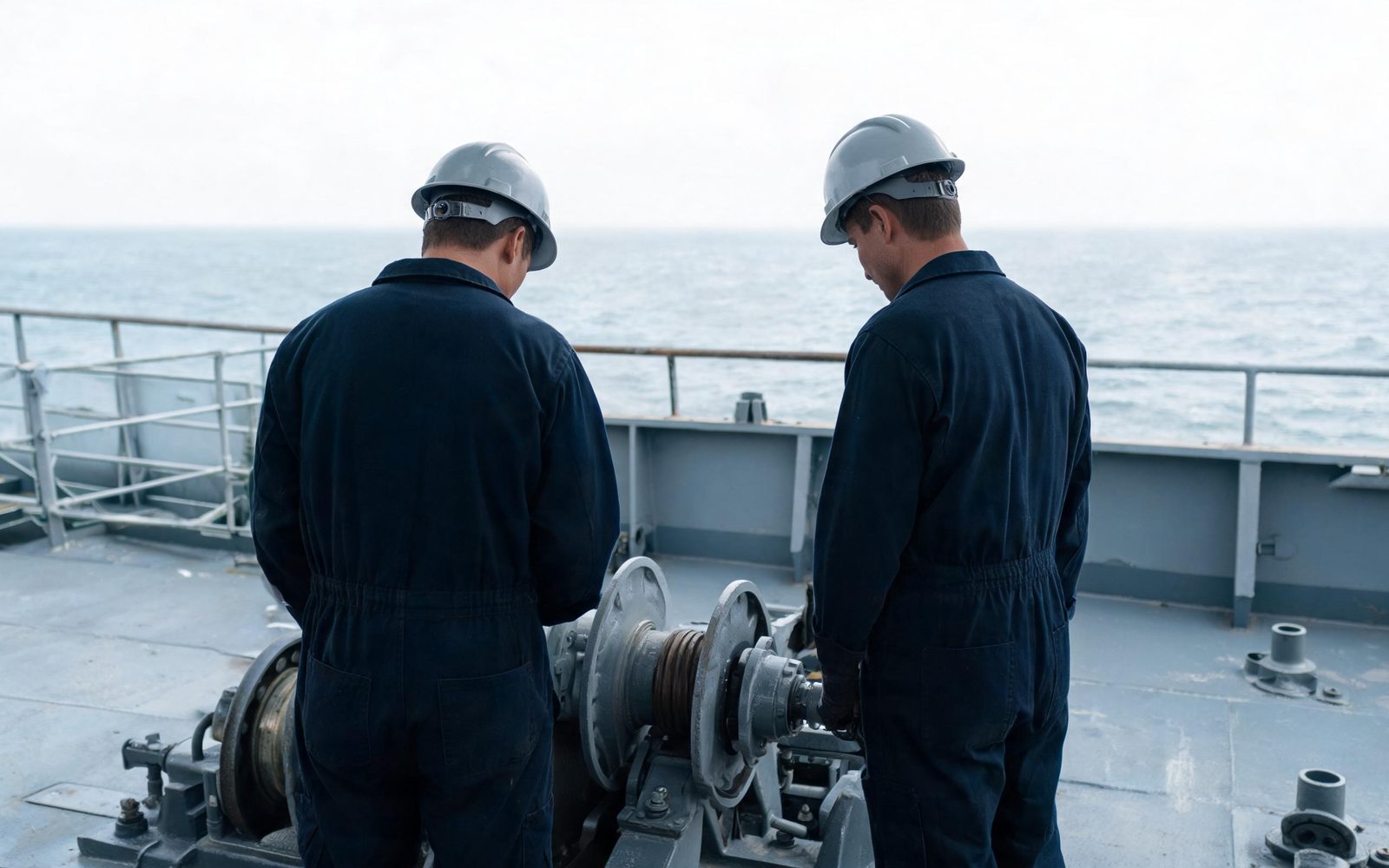
The merchant navy is the commercial side of seafaring: the crews who operate cargo ships, tankers, container vessels and bulk carriers in international trade. It is distinct from a national navy, which is a state's armed maritime service. For someone in Pakistan considering a career at sea, the practical question is not whether the work exists — Pakistan has a long-established seafaring tradition and supplies crews to ships worldwide — but which route into it suits their qualifications, and what the pathway actually involves.
This explainer sets out how the system is structured, what certification governs it, and where the common points of confusion lie. It is written for people weighing the decision and for institutions that advise them.
Why certification, not employers, governs this career
The single most important thing to understand about a merchant navy career is that it is regulated internationally rather than by any one shipping company. The International Convention on Standards of Training, Certification and Watchkeeping for Seafarers, known as STCW, sets the minimum standards that seafarers must meet and that national administrations must certify. A Pakistani seafarer's certificate is recognised internationally because Pakistan is a party to that framework.
The practical consequence is that progression at sea is driven by documented sea service and certification, rather than by seniority inside one company. Each step — from cadet to watchkeeping officer to chief officer and eventually master, or from engine cadet through the engineering grades — requires a defined period of sea service and a certificate of competency issued by the national administration.
- STCW sets the international minimum standards for training and certification.
- National administrations issue certificates of competency and proficiency.
- Progression depends on verified sea service plus examination.
- Certificates are portable across flags and companies, which is why they matter more than any single employer.
The two main departments aboard a ship
Merchant vessels are crewed through two parallel departments, and the entry requirements differ.
- The deck or nautical department is responsible for navigation, cargo operations, watchkeeping and the overall conduct of the voyage. Officers in this department progress towards chief mate and master.
- The engine department is responsible for propulsion machinery, electrical systems, auxiliary equipment and maintenance. Officers progress towards second, chief and eventually chief engineer.
Entry routes into the industry
There are broadly three ways in. Which one applies depends on a candidate's age and academic background.
The first is the cadet route. A candidate with the required school qualifications enters a maritime training institution, completes an approved programme, and then serves a period of supervised sea service as a cadet before sitting examinations for a certificate of competency. This is the standard path to an officer career, and it is the route that most people mean when they talk about joining the merchant navy.
The second is the rating route. A candidate enters at the support level — as a deckhand, oiler, wiper or similar — and works up through the ratings, with the possibility of later transferring to an officer pathway subject to meeting the academic and training requirements. This route has a lower entry threshold but a longer progression path.
The third is a lateral entry for people who already hold qualifications. Those with an engineering or electrical background may enter the engine department through an approved workshop and sea-service programme, and graduates in related fields sometimes enter through accelerated arrangements where these exist.
What actually decides admission
Because entry requirements and admission windows change from year to year, the only reliable source is the institution or administration concerned. Pakistan Marine Academy, which is the principal national maritime training institution and operates under the Ministry of Maritime Affairs, publishes its own admissions criteria and schedules. Candidates should treat third-party summaries — including this one — as orientation rather than authority.
That said, the general shape of the requirements is stable across maritime training systems internationally: a minimum age in the late teens, completed secondary schooling with a science background for the officer pathway, a medical fitness standard that is more demanding than for most shore careers, and an entrance assessment. Colour vision, hearing and physical fitness standards matter because they are tied to the ability to stand watch and respond in an emergency.
The sea-service requirement is the real bottleneck
Almost every description of the seafaring career omits the step that most often delays people: obtaining sea service. Certification requires it, and certification is what unlocks promotion. But berths for cadets are limited, and a cadet cannot simply arrange their own placement on an internationally trading vessel.
This is where the structure of the industry matters. Training berths depend on arrangements between training institutions, shipping companies and manning agencies. When those arrangements are healthy, cadets move through the system on schedule. When they are not, qualified trainees wait ashore — having completed the academic stage but unable to accumulate the sea time that their next certificate requires.
For anyone planning a career, this is the single most useful question to ask of any programme: what proportion of graduates obtain their required sea service, and how long does it take? A second and related question is whether the programme's certification is recognised by the administration that will later issue the certificate of competency.
Working conditions, and what to weigh up
Life at sea involves long absences, a compressed working environment, and a rotation system that commonly runs to several months aboard followed by a period ashore. The work is technical, safety-critical and governed by international regulation covering hours of rest, medical standards and crew welfare.
The international framework for seafarer welfare is set by the Maritime Labour Convention of the International Labour Organization, which establishes minimum standards on living conditions, hours of work and rest, medical care and repatriation. Knowing that this framework exists is useful, because it means seafarers have defined entitlements rather than only contractual ones.
The case for the career is straightforward: it is a genuinely international profession with clear, portable qualifications and a structured progression path. The case against is equally clear: the separation from family life is significant, and progress depends on berths and examination outcomes that an individual does not fully control.
Where Pakistan's seafarers sit in the global picture
International seafarer supply is concentrated in a limited number of countries, and Pakistan is among the established suppliers. That position is commercially meaningful: seafaring is a services export, and remittances from seafarers are a visible part of the balance of payments in supplying countries.
It is also a position under pressure. The Seafarer Workforce Report published by BIMCO and the International Chamber of Shipping in 2026 estimates a global shortfall of 39,100 certified officers, alongside a surplus of ratings — a combination that suggests the demand is concentrated at the officer level. For a supplying country, that distinction is the strategic one: numbers of seafarers matter less than how many of them hold officer certificates.
Frequently asked questions
- Is the merchant navy the same as the Pakistan Navy?
- No. The Pakistan Navy is the country's armed maritime service. The merchant navy is the commercial fleet — cargo ships, tankers and container vessels — crewed by civilian seafarers. The training and certification systems are entirely separate.
- Do I need a degree to become a deck or engine officer?
- The officer pathway typically requires completed secondary schooling with a science background, followed by an approved maritime training programme and sea service. Specific academic thresholds are set by the training institution and the national administration, and change from year to year, so confirm current requirements directly with them.
- Can a rating become an officer later?
- It is possible in many maritime systems for ratings to transfer to an officer pathway after meeting defined academic and training requirements, sometimes with sea service counted towards the officer programme. The conditions are set by the national administration, so the practical step is to ask it directly.
- Why do people wait for a ship after finishing training?
- Because certification requires verified sea service, and training berths are limited. Placement depends on arrangements between training institutions, shipowners and manning agencies, so the availability of berths — not academic completion — usually determines how quickly a cadet progresses.
Conclusion
The merchant navy pathway in Pakistan is well established but structurally gated: academic training opens the door, and sea service determines how far and how fast someone moves. Anyone advising candidates — a school, a family, an institution — should focus on that second gate as much as the first, because the availability of training berths is what converts qualifications into careers.
For institutions, the wider question is a policy one. A country that supplies seafarers to the world fleet is competing in a market where officer certificates command the premium. That makes the capacity and quality of maritime education, and the strength of the link between training institutions and shipowners, a matter of national economic interest rather than only of individual career choice.
PMRC studies these questions as part of its work on the merchant navy and seafaring workforce, including training capacity, certification pathways and the connection between national maritime education and international demand.